

This Session's Deep Dives
Builds members shared during Show & Tell, expanded into a step-by-step you can run yourself.
He rebuilt his quarterly roadmap workshop as a live tool — and the whole room used it
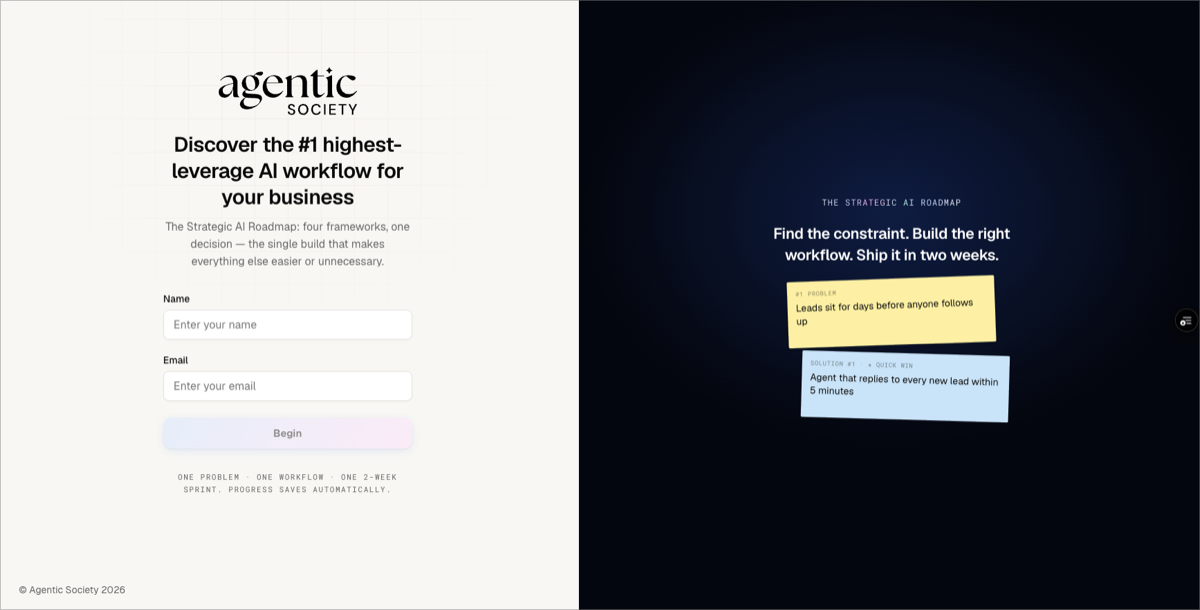
The problemOperators leave masterminds with ten ideas and build none of them.
Austin took the roadmap workshop he's run quarterly with past teams (including at Jasper) and rebuilt it as a live tool at agenticsociety.com/roadmap, built with  Claude for this exact session. Four steps: dump every bottleneck in the business, plot each on a pain/frequency matrix to find the highest-value problem, brainstorm every way to solve it (hire, buy, build), then plot the options on an effort/impact matrix to find the quick win instead of the big bet. He ran his own example live — front-desk staff manually texting every ad lead — and showed why the first domino (
 GoHighLevel A2P registration) beats the ambitious agent build, because it unlocks CRM access for every future agent. Everyone left with a downloadable markdown build plan to hand to their own AI.
- Problem dump → pain/frequency matrix → solution brainstorm → effort/impact matrix
- Pick exactly ONE two-week sprint — the domino that makes everything else easier
- Export a markdown build plan and hand it to your own AI to execute
All nine members worked the tool live and locked one sprint commitment each, reviewed at the next Boardroom.
- agenticsociety.com/roadmap
- Claude
- GoHighLevel
- Problem dump: list every repetitive, manual, expensive, or slow thing — and what breaks at 10x demand
- Plot each problem on the pain/frequency matrix; pick the most frequent, most painful one
- Brainstorm every solution without judging: hire, buy software, or build
- Plot solutions on the effort/impact matrix; take the quick win, not the big bet
- Lock exactly one two-week sprint and export the markdown build plan for your AI
You are my AI chief of staff running The Strategic AI Roadmap exercise from the Agentic Society Boardroom (July 2026). Interview me in four rounds: (1) problem dump — ask me what is repetitive, manual, expensive, or slow in my business, what would break under 10x demand, and what role I would hire next and why; (2) score each problem by frequency (daily to quarterly) and pain, and tell me which one is the most frequent AND most painful; (3) for that one problem, brainstorm every solution across hire / buy / build without judging; (4) score each solution by effort versus impact and recommend the quick win — especially any 'first domino' that unlocks bigger builds later. Output: a one-page markdown build plan for a single two-week sprint with success criteria I can hand to my AI employees. Push back if I try to pick more than one project.
Takeaway Don't pick the big bet. Pick the quick win that unlocks the big bet.
Run The Strategic AI Roadmap exercise yourselfHe built a CEO dashboard where AI agents and humans work the same board — then unveiled Lilybug
~300 launch video assets generated pre-launch with Higgsfield
The problemRunning a portfolio of companies means KPIs, cash, and projects scattered across tools and people.
Chance demoed a custom CEO dashboard that pulls live KPIs and cash-on-hand per company, has a built-in AI coach he can toggle between Claude and  ChatGPT, and a Kanban board where AI agents and his human chief of staff work side by side — agents build their own checklists, work autonomously, and flag anything blocked by a human straight onto that person's priority list. Then the bigger reveal: he's launching Lilybug, an agentic mechanical/electrical/plumbing company, with partners who've had multiple nine-figure exits — aiming to be the most agentic company in the trades, starting in Texas. The AI-forward approach shows up in the field: crews presenting instant pricing and financing on iPads, and ~300 marketing video assets already generated with Higgsfield before launch at a fraction of traditional production cost.
- Live KPIs + cash-on-hand per company in one view
- AI coach (Claude ↔ ChatGPT toggle) built into the dashboard
- Shared Kanban where agents self-checklist and route blockers to the right human
A portfolio command center running today — and an agentic trades company launching on top of the same playbook.
- Wire live KPIs and cash-on-hand per company into one dashboard view
- Add an AI coach with a model toggle (Claude ↔ ChatGPT) that reads the same numbers
- Run projects on a shared Kanban where agents self-generate checklists
- Route anything agent-blocked straight onto the responsible human's priority list
- Pre-generate launch marketing assets with Higgsfield before the brand goes live
You are my new operations engineer, modeled on the CEO dashboard shared at the Agentic Society Boardroom (July 2026). Build me a portfolio command center. Interview me first: (1) which companies or business units I run and where their KPIs and cash data live, (2) which project tool my team uses today, (3) which humans should receive escalations. Then implement in phases: Phase 1 — a dashboard that pulls live KPIs and cash-on-hand per company into one view. Phase 2 — an AI coach panel that can toggle between Claude and ChatGPT, reads the same live numbers, and answers questions about them. Phase 3 — a shared Kanban board where AI agents create their own checklists per project, work autonomously, and flag anything blocked by a human directly onto that person's priority list. Hard rules: read-only access to financial systems, and every agent action lands in an audit log I can review.
Takeaway Make the AI visible in the customer experience, not just the back office.
His editing pipeline turned a 45-minute interview into 7.5 minutes — in about an hour
45-min interview → 7.5-min edit in ~1 hour (vs ~8 hours manual)
The problemEditing long interview footage down to the good parts eats a full working day per video.
Nick walked through his near-plug-and-play Premiere Pro pipeline: an indexing model labels every clip and its content, per-clip metadata gets stored, then each take runs through OpenCV using Lucas-Kanade optical flow to measure camera shake and flag whether it's usable — all piped into Premiere over an MCP connection. On a real 45-minute talking-head interview, the system produced a 7.5-minute edit in about an hour of his time, versus roughly eight hours by hand. He also got the Meta MCP working with Claude and launched his first ad campaign: 18 leads in two days.
- Indexing model labels each clip; metadata stored per take
- OpenCV + Lucas-Kanade optical flow scores camera movement and flags usable takes
- MCP connection drives the actual Premiere Pro edit
A repeatable editing pipeline he can package across his client portfolio.
- Premiere Pro
- OpenCV
- Claude
- Meta MCP
- Index the footage: a model labels every clip and what's said/shown in it
- Store per-clip metadata so the pipeline can reason about takes
- Score each take's camera movement with OpenCV Lucas-Kanade optical flow; flag unusable shake
- Drive the actual Premiere Pro edit over an MCP connection
- Human pass at the end for emotional beats — the machine picks selects, you keep the feeling
You are my new video-edit assistant, modeled on the editing pipeline shared at the Agentic Society Boardroom (July 2026). Your job: turn long interview footage into a tight selects edit with minimal human time. Interview me for: (1) my editor (Premiere or other) and whether an MCP connection exists for it, (2) a sample of raw footage, (3) my target output length and style. Then implement: an indexing pass that labels every clip and its content into per-clip metadata; a quality pass that measures camera movement per take (OpenCV Lucas-Kanade optical flow or equivalent) and flags unusable shake; a selects pass that assembles the best takes into a rough cut in my editor; and a handoff note listing every emotional-beat decision you were unsure about so I can finish by hand. Track your time savings against my manual baseline.
Takeaway The edit isn't the art — the selects are. Automate the selects.
 Austin Distel
  Prashant Vanka
  Lauren Goldstein




 The Strategic AI Roadmap tool
  Bitterclip
  Higgsfield
  Hermes