
Live In-Person Mastermind | Austin, TXLimited spots left, get on the guest list

In this Mastermind, we talked about…

Company brains, Cursor for video, and a four-agent social team.

  • Friday, September 4, 2026 · 12:00 PM – 3:00 PM
  • Industrious, Austin, TX

See how fellow entrepreneurs in Austin, TX are using AI Agents to grow their business.

During this AI Mastermind & Mixer, attendees submitted the most impactful AI Agents they've deployed and then everyone voted on the outcomes they wanted to hear a deep-dive on. Below, you'll see the outcomes with AI, who submitted it, and what we explored by popular demand.

  • 🏆

    Built a team of 4 AI agents run my social media content including Research, Copy, Video Editing, Hashtags and Posting for 20+ posts per week. Taking the process from ~8hrs per week to 1 Hour of recording per week.

    ▲ 15
    Read the deep dive ↓
  • 🏆

    I built a chat based video editor that increased the speed of video editing by 10x - captions, graphics, and more. So that editing is no longer the bottleneck to content marketing.

    ▲ 13
    Read the deep dive ↓
  • 🏆

    We built a Brain Factory that plugs into every source a company already runs on, calls, email, Slack, docs, CRM, finance, and extracts not just the nouns but the verbs, what was decided, why, and what it depends on, into one living knowledge graph per company with an agent on top

    ▲ 12
    Read the deep dive ↓
  • I’m acquiring law firms. Built ever-growing Private LLM & company brain to drive our platform firm’s tasks. Replaced Slack, Asana, CRM (90%). Processing client docs, generating reports, etc. Compliant for sensitive client data (financial & health). http://www.LawFirmPartners.com

    ▲ 11
  • Built an AI Growth System that turns founder knowledge into positioning, content strategy, and 80% publish-ready LinkedIn posts. The first 10 posts generated $140K in new revenue.

    ▲ 11
  • Saved $20k/yr replacing an enterprise email tool. Saved $2k/yr replacing website tech stack. Project based - not autonomous agentic.

    ▲ 6
  • Perfect out on every project with a council of 5 AI advisors and 6 rounds of EBI, one shot every time, never iterate again.

    ▲ 5
  • We created a team of agentic CRM agents that handle sales tasks from new lead to contract signed. It allowed us to not hire 2 more employees.

    ▲ 5
  • Created a templated daily Instagram carousel post called RANKED using an agent in perplexity computer. It created a calendar of topics across 7 content categories (music, sports, travel destinations, hotels, comedy, venues) then created the full package to be posted daily.

    ▲ 4
  • I built an AI agent that scrapes the internet for the latest trends in wellness/ longevity/ via Apify. The agent creates 10 hooks, I choose the ones I like, AI writes the scripts, grabs the images via Flux, organizes in sheets for editor, then creates a pocket guide 4 manychat

    ▲ 4
  • I created an AI workflow to not only analyze sales calls, but also identify rep and team gaps for targeted training. Because it's public, a new salesperson set a close rate record by training what others were missing.

    ▲ 3
  • We train AI to analyze acquisition deals based on the investment thesis / decision-making criteria of our head M&A Advisors at our firm. Analysis is done using the company tax returns, financials, CIM, etc.

    ▲ 3
  • I’ve build an webapp audit for founders free to use called „Genius Zone Audit“ which assess all the hats they are wearing and mirrors them back, which bottleneck to take care for first. It created 8 new clients through the follow up email sequence on the first month.

    ▲ 3
  • Used Claude code, Copilot to navigate regulatory hurdles and rebuild healthcare website and staff training guides. Aim is to build AI agents to assist with patient care

    ▲ 2
  • Multi-agent system for a legal tech company that automates the process of generating an Estate (Will). Their estate lawyers couldn't handle the interest from customers; so this solution unblocked revenue.

    ▲ 2
  • Created an AI bot that runs out inventory management system and allows us to change how it operates via a slack channel.

    ▲ 1
  • Landed GoHighLevel as a sponsor for my upcoming comedy game show in October sparked from a direct outreach about to their affiliate, partner & executive team using Claude Code with Firecrawl and Clay to find the right people to connect with and reach out via email and LinkedIn.

    ▲ 1
  • I was able to build a system of agents that helped our Amazon brand increase revenue by 3x in the past 5 months.

    ▲ 1
  • I created waterfall system to pick the best model at the lowest cost

    ▲ 0
The room voted

Top 3 Voted AI Agents

Every owner shared one real result from the last 90 days. These are the three the room chose to go deep on.

The Brain Factory: one living knowledge graph per company

Graph build cost fell from roughly $600 and four hours on a frontier model to $40–$60, with up to 40% more document density and relationships

The problemRoughly 20 million US mid-market businesses run on a million to fifty million a year and have nobody on the team who can be the technical implementation layer — so enterprise-grade context is out of reach, and the DIY answer is a flat file brain that only traverses one direction and cannot tell you what is still true.

Isaiah and his co-founder Christopher Schenk build company brains for mid-market businesses. His argument is that context engineering comes down to understanding how memory systems work, and that the common advice — set up a markdown knowledge graph, put it in a notes app, search it globally — produces something that is not living. It is flat-path: it traverses one direction and never crosses the multiple dimensions of relationship between your data. What changed is cost. A few months ago, at one of these same events, he sat with his laptop open backfilling one of his own internal graphs; on a frontier model that run cost about six hundred dollars and burned four hours. Today the same graph costs forty to sixty dollars to build, and document density and the number of relationships between documents have gone up by as much as forty percent. That collapse in price is what moved company brains from bespoke consulting to something the platform can produce for almost nothing. The architecture underneath is a true graph RAG retrieval system — semantic search plus BM25, a chunking layer, a vector layer, and an agent layer on top — and the piece Isaiah stresses most is temporal evidence. Time-bound weighting is what stops the brain from pulling something from March, presenting it as current, and telling you to call a person who was let go or restart a campaign you killed. His framing for the whole category: the company brain is not the product, it is the enablement layer for the agent layer. Plenty of people in the room have already built a second brain and handed it to an agent — the open question is what you do with it next.

What they built
  • Connect the systems the business already runs on — calls, email, Slack, docs, CRM, finance — through API connectors.
  • Backfill everything through a pipeline that extracts not just entities but decisions: what was decided, why, and what it depends on.
  • Build a graph RAG layer over it — semantic search and BM25, chunking, vectors, and full graph edges — with temporal weighting so recency is a first-class signal.
  • Spin up the agent fleet automatically once the graph exists, drawing from a library of over 200 skill profiles.
  • Apply role-based access control across the brain, so each agent and each person sees only what they should.
  • Deliver it wherever the team already is — Slack, Telegram, or plain text message — because they are all just agents underneath.
  • Keep the whole thing self-hostable and exportable, so the client can leave with their graph.
Outcome

A company brain that any agent can query, that keeps improving from the business's own communication, and that stays portable across model providers — delivered for a monthly platform fee rather than an enterprise data project.

Key takeaways
  • Flat second brains only traverse one direction. What makes a brain useful to an agent is the relationships between documents, plus a sense of what is recent.
  • Knowledge graph builds got roughly ten times cheaper in a few months. Work you priced as bespoke last quarter is now near-free to produce.
  • Time-bound evidence is the feature. Without it your brain confidently serves stale context — a fired employee, a dead campaign — and the agent acts on it.
  • Build a harness, not a wrapper. Your company brain should be an asset you can point at any model provider.
  • Role-based access control matters as soon as more than one person uses it. Scope agent knowledge the way you scope Slack permissions.
The playbook: build it yourself
  1. Pick the systems that actually hold your decisions — not just your documents. Calls, email, chat, CRM and finance are where the reasoning lives.
  2. Stand the storage layer up somewhere you control, and treat it as portable from day one. A container you can export beats a platform you cannot leave.
  3. Backfill historically before you automate anything. The brain needs to be a historical document first; the runtime piece is what gives agents context of what already happened.
  4. Add temporal weighting immediately. Decide what recency means for your business — an e-commerce catalog changes far faster than a contracting engagement that takes weeks to reach signature.
  5. Choose your refresh trigger to match how active the business is: every ten commits, every fifty chat messages, hourly, or nightly.
  6. Write a standing rule into your agent's instructions: always search the graph for context, then confirm it through live memory and tool calls before acting.
  7. Only then build the agent layer on top, and scope each agent's access to the knowledge it actually needs.
  8. If you handle regulated data, keep it local. Scrub personal health information and identifiers on your own hardware, and sign data processing agreements with every API provider you send information to.
Hand it to your AI employee
You are helping me design a company brain that my AI agents will use as their shared context. Do not write any code yet.

First, interview me about my business: what systems hold our real decisions (calls, email, chat, CRM, finance, docs), how many people are on the team, and how fast our facts change.

Then produce:
1. An inventory of every source worth ingesting, ranked by how much decision-context it holds versus how hard it is to connect.
2. A recommended storage and retrieval design that I can self-host and export, and that I can point at any model provider — explain where semantic search, keyword search, and graph relationships each earn their place for MY data.
3. A recency policy: for each source, how stale is too stale, and what should trigger a refresh.
4. The standing instruction to put in my agent's rules file so it always checks the graph for context and then confirms against live tools before acting.
5. An access matrix: which agents and which people should see which parts, and what should never be ingested at all.

Flag anything that would need to stay on local hardware for compliance reasons, and tell me what you would build first if I only had one week.

Takeaway Do not think of the company brain as something the model providers will eventually absorb. It is an asset you need for yourself, and it happens to work with any language model.

Frame Controller: Cursor for video, running on cheap models

~12x faster content pipeline, running on cheap Gemini Flash-class models rather than a frontier model

The problemVideo editing was the bottleneck on content marketing. The real drudgery was not cutting bad takes — it was placing a graphic on screen from here to here, by hand, every single time.

Josh spent six years as a content creator and coach before his best friend started teaching him to code; five or six months ago he went all in and built a video editing application. The pitch is a chat-driven editor, and he is candid that the first two things it does — chat-based cuts, then captions — are what everybody has. Where it separates is that you can ask it to restyle the captions, and it goes and reads the emotional payload of each individual word in the transcript, decides whether that word is positive, negative or an emphasis beat, and styles it accordingly. From there you can talk to it about graphics: remove these captions, add a supply and demand diagram, make it for YouTube with big bold graphics and no small details, give the background a frosted-glass transparency. It codes that, measures what it produced, screenshots its own output, notices when it did a bad job, and tries again. The framing underneath is the part worth stealing. Josh calls the number one problem of AI the fact that ninety percent of it is the best thing you have ever seen and ten percent is unusable — and therefore all of it is unusable. His answer is that the solution is not to make AI perfect, it is to make AI capable of adjusting. He is an obsessive student of learning theory, with about two million followers writing about it, and he sees agents mirroring human development: it is not about getting it right, it is about being able to get it right over time. That belief shows up in his cost structure. Frame Controller runs on cheap, fast, deliberately unimpressive models rather than a frontier model, and it works because of the training around it — give an agent the ability to fetch the instruction it needs when it needs it, the ability to check its own work afterwards, and guidelines to check against, and it will do good work regardless of which model is behind it.

What they built
  • Take a rough cut and let the chat interface handle the mechanical cuts and the dead air.
  • Generate captions, then restyle them by asking — the system reads each word's emotional payload and styles for emphasis rather than applying one uniform look.
  • Describe the graphic you want in plain language, including platform, weight and background treatment, and let it write the code for it.
  • Let it screenshot and grade its own output, then correct itself until it matches the description.
  • Drop in a screenshot of any design you like and ask it to match that as a style reference, or paste a paragraph of style direction as a reusable preset.
  • One-shot the whole chain once you trust it — everything demoed as separate actions can run as a single instruction.
  • Drive it from outside with an API connection, pointing an agent at a folder of raw video to process in bulk.
Outcome

Editing stopped being the constraint on publishing. Josh went from not being able to post videos fast enough to being able to, his editor got happier, and the pipeline speed improved by roughly an order of magnitude.

Key takeaways
  • The solution is not a perfect model, it is a model that can adjust. Build the correction loop and the ten percent failure rate stops being fatal.
  • Training beats model size. A well-instructed cheap model that can check its own work will beat a frontier model with sloppy instructions.
  • Deliberately test on a bad model. If it goes hog-wild, your instructions were the problem, not the model.
  • Automations do not compose; agents do. A single process cannot become another process, but an agent with the capacity for individual action can become many automations.
  • For talking-head educational content, the graphic that converts is usually the plain diagram, not the generated art.
The playbook: build it yourself
  1. Separate the drudgery from the craft. List the edits you repeat mechanically on every video — those are the ones worth handing to an agent first.
  2. Build on a frontier model so you can see the ceiling of what is possible.
  3. Then deliberately re-run the same task on a much cheaper, weaker model.
  4. Watch where the weak model goes off the rails. Every failure is a gap in your instructions, not a verdict on the model.
  5. Rewrite the instructions to close those gaps, and give the agent a way to fetch the right instruction at the moment it needs it.
  6. Add a self-check step: have it screenshot or measure its own output and grade it against the brief before returning.
  7. Give it explicit guidelines to check against — this is what lets a cheap model produce good work.
  8. Keep granular manual control available for the ten percent it gets wrong, so one bad frame does not make the whole output unusable.
  9. Only once each action is reliable in isolation, chain them into a one-shot instruction.
Hand it to your AI employee
I want to move a repetitive production workflow onto cheap, fast models instead of a frontier model, and I want it to be reliable.

My workflow is: [DESCRIBE IT — e.g. editing talking-head video, producing carousels, formatting reports].

Help me do this in the following order:
1. Break the workflow into individual actions. For each one, say whether it is mechanical drudgery (automate first) or genuine craft (keep human).
2. For each mechanical action, write the instruction set an agent would need — including how it fetches the context it needs at the moment it needs it.
3. Design a self-check for each action: what should the agent measure or screenshot to grade its own output, and what does the brief look like that it grades against?
4. Give me an explicit guidelines document the agent can check against.
5. Tell me how to test this: I will run it on a frontier model first, then on a deliberately weak model. Tell me what failure modes to watch for and how to read each one as a gap in my instructions rather than a limit of the model.
6. Identify where I must keep granular manual control, so one bad output does not make the whole result unusable.

Assume I would rather spend an hour improving instructions than ten times as much per run on a bigger model.

Takeaway The solution isn't really to make AI perfect. The solution is to make AI capable of adjusting.

See Frame Controller

Four agents, twenty posts a week, one hour of recording

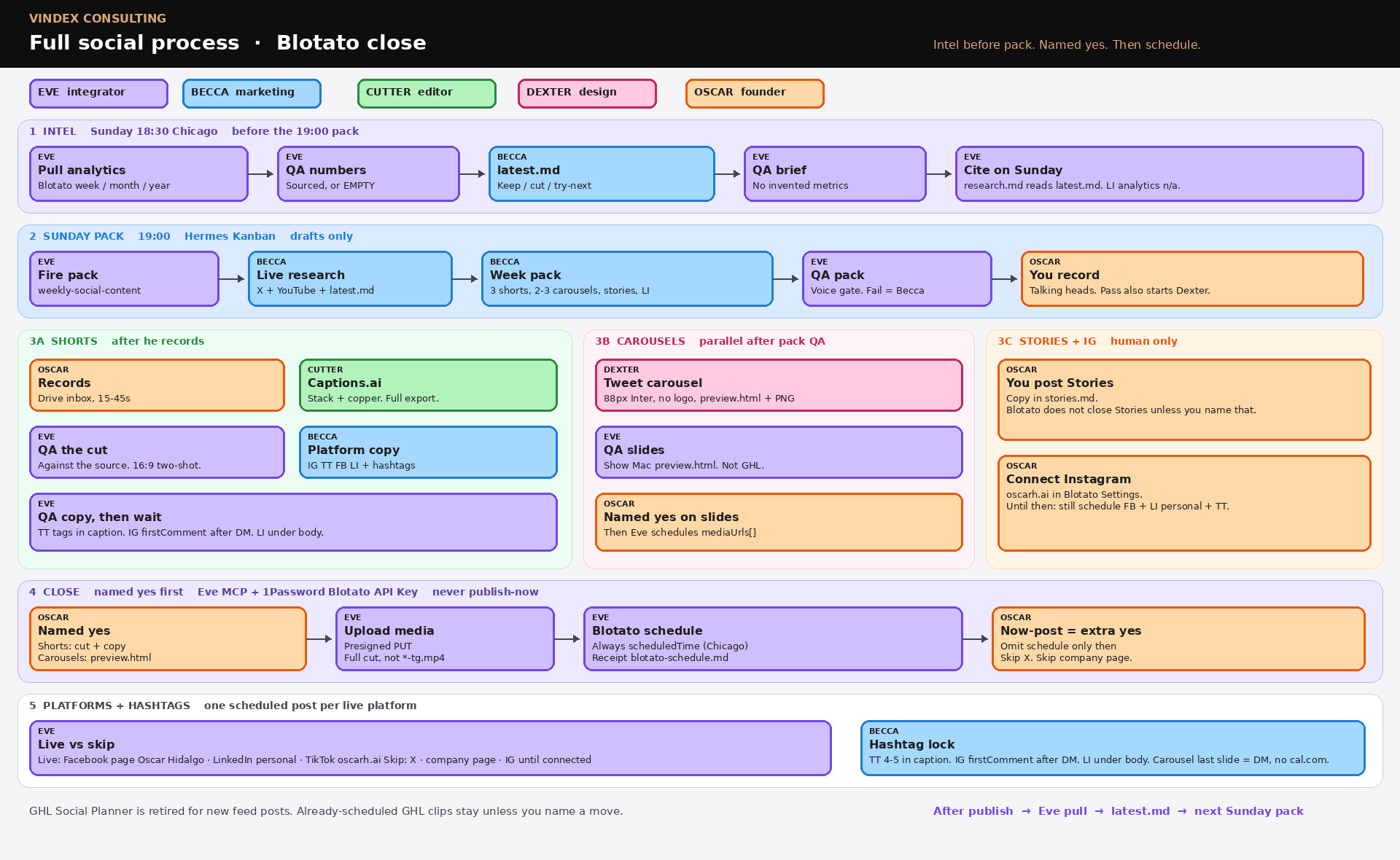
Oscar Hidalgo's social media work graph: lanes for intel, the Sunday pack, shorts, carousels and stories, the Blotato close, and platforms — showing which of his agents owns each stage and where it hands off

20+ posts per week, with the process going from roughly 8 hours a week to 1 hour of recording

The problemOscar runs an HVAC company and an AI consultancy, and between the two businesses and a young family he had zero time for social media — which the consulting business needed in order to grow.

Oscar is the CEO of an HVAC company who taught himself AI on YouTube, started an AI consultancy called Vindex Consulting for small and mid-sized service businesses, and joined the Agentic Society as its Hermes trainer. He is emphatic that he is not a technical founder — he has done operations for about ten years, and he approaches AI agents exactly the way he approaches hiring people: think about the SOP, think about the process, think about what the job description would be, then brainstorm it with Claude until something is built. He had been accumulating one agent per small task, and spent the last month consolidating them into the main roles at the top of his company: a marketing agent, an operations agent, a developer agent. The build he presented is a work graph for social media, where each agent owns one stage and hands off to the next. Eve is his integrator — the concept borrowed from Traction — and she is the only agent he talks to. She holds the most context, reviews other agents' output, and assigns the Kanban tasks, which means he never has to chase individual agents or remember their names. The run fires Sunday night: pull last week's, month's and year's analytics from Blotato, QA the numbers, hand off to Becca the marketing agent to research what the AI discourse is actually about this week using the X and Gemini APIs, and come back with topics for three short-form videos and a set of carousels. A skill trained on all of Oscar's emails and communications then quality-controls the output against his real voice before it reaches him in Notion. He records, his agents pick the video up out of Google Drive through browser automation on a virtual Linux machine, edit it in a web-based tool, put it back, and Becca writes platform-specific copy — short for TikTok, long for LinkedIn — plus the hashtag research and the carousels. The only thing left on Oscar is recording and posting stories.

What they built
  • Map the whole process as a work graph before building anything, using a diagramming tool so you can iterate on it conversationally with your agent.
  • Appoint one integrator agent as your single point of contact — it holds context, reviews output, and assigns work to the specialists. Oscar's four are Eve the integrator, Becca on marketing research and copy, Cutter on editing, and Dexter on design.
  • Create each specialist with narrow skills and narrow tools so it is reliably good at one stage.
  • Trigger the run on a schedule — Oscar's fires Sunday night — starting with last week's performance analytics.
  • Have the research agent determine what the market is actually discussing this week, rather than generating topics from nothing.
  • Gate the output through a skill trained on your own communications, so the voice is yours before you ever see it.
  • Deliver the pack to a place you actually work from, ready to record.
  • Let the agents handle editing via browser automation and then write platform-specific copy, hashtags and carousels for each destination.
Outcome

Oscar sits down once a week, records three videos from topics that are already researched and scripted in his own voice, drops them in a folder, and the fleet produces and schedules twenty-plus posts a week across platforms.

Key takeaways
  • Give yourself one agent to talk to. An integrator that holds context, QAs the others and assigns the tasks means you are not chasing a fleet.
  • One agent, one job. Narrow skills and narrow tools make each agent reliably good, and the handoffs are where the design work lives.
  • Design backwards from the outcome, then map the roles you would hire if they were people.
  • Train a skill on your own writing and use it as a quality gate, so scaled output still sounds like you.
  • Pick web-based tools when agents need to operate them — browser automation on a virtual machine can drive a web app but not a desktop one.
  • Swapping a tool becomes a one-step change once the process is a graph, not a script.
The playbook: build it yourself
  1. Start from the goal and move backwards. Define what fully automated looks like, then ask what roles you would hire if they were people.
  2. Draw the work graph before you build. Have your agent map it in a diagramming tool so you can go back and forth on the design.
  3. Name one integrator as your single interface, and give it the agent-review and task-assignment skills.
  4. Build each specialist narrow — specific skills, specific tools — and make the handoff between stages explicit.
  5. Open the run with your own performance data so topic selection is grounded in what already worked.
  6. Add a research stage that reads live discourse, so you are contributing to a conversation that is actually happening.
  7. Train a voice skill on your existing emails and writing, and use it as a QA gate on every output.
  8. Choose web-based production tools so browser automation on a virtual machine can operate them.
  9. Add a recursive step: feed the performance of what published back into next week's topic selection.
  10. Keep the genuinely human parts human — Oscar still records, and still posts stories himself.
Hand it to your AI employee
Act as my operations designer. I want to hand a recurring content process to a small team of AI agents, and I want to design it the way I would design a team of people.

My situation: [YOUR BUSINESS], and the recurring output I need is [e.g. three short videos and two carousels per week].

Work in this order:
1. Start from the finished outcome and work backwards. If I were hiring humans for this, what roles would exist, and what would each one's job description and success measure be?
2. Turn that into a work graph: the stages, who owns each, and exactly what gets handed from one stage to the next. Describe it so I can draw it, and flag where a handoff is likely to break.
3. Recommend one integrator agent as my single point of contact. Define what context it holds, what it reviews, and how it assigns work.
4. For each specialist, give me the narrowest useful skill set and tool list — one agent, one job.
5. Tell me where in the graph my own performance data should enter, so topic and priority decisions are grounded rather than invented.
6. Design a voice quality gate: what should I train it on, and what should it check before output reaches me?
7. Tell me which tools need to be web-based because agents will operate them through browser automation, and which steps should stay manual because they are genuinely mine.

End with the smallest version I could run this coming week, and the one recursive improvement to add after that.

Takeaway I go about AI agents the same way I go about hiring employees. I think about SOPs, I think about processes, and I think about what the job description would be.

Vindex Consulting

Big ideas

The patterns that kept surfacing, with the people who said them best.

  1. 01

    Build a harness, not a wrapper.

    A wrapper breaks the minute the model gets bigger and more capable. A harness is designed to move with the model. Your development environment is your custom harness, and your company brain should sit inside it as an asset you own — pluggable into any provider, self-hostable, exportable.

  2. 02

    Time-bound evidence is what makes a second brain trustworthy.

    Without recency weighting, a brain will pull something from March, present it as current, and have your agent act on it — calling a person who was let go, or restarting a campaign you killed. Decide what stale means for your business and set the refresh trigger to match how fast you actually move.

  3. 03

    Training beats model size.

    Give an agent the ability to fetch the instruction it needs when it needs it, the ability to check its own work afterwards, and guidelines to check against, and it will do good work no matter which model is behind it. Build on a frontier model, then deliberately re-run on a weak one — where it goes wrong is where your instructions were thin.

  4. 04

    Automations do not compose. Agents do.

    An AI automation is a singular process, and a singular process cannot turn into another process. But if you teach something to become an agent, where it develops the capacity for individual action, it can become many automations.

  5. 05

    Give yourself one agent to talk to.

    Nobody wants a dozen direct reports. Appoint an integrator that holds the most context, reviews the other agents' output and assigns the tasks, so everything comes through one channel and you never have to remember an agent's name.

  6. 06

    Design backwards from the outcome, then hire the roles.

    Start from what fully automated looks like, ask what roles you would hire if they were people, and build each agent narrow — one job, specific skills, specific tools. The design work is in the handoffs.

  7. 07

    The second brain is your first graduation.

    The company brain is necessary no matter what — it is the layer underneath that carries the context, so you are not re-prompting your brand, your colors and your offer every single time. Get that before you start building agents.

  8. 08

    It is the off-post activity that affects the on-post reach.

    People assume posting natively beats scheduling. Across more than 300 posts the finding was that scheduling itself is close to neutral — what moves the algorithm is engaging, commenting and sending DMs before you post. If someone on your team is doing that warm-up, schedule freely.

  9. 09

    Find the constraint, then hire the agent for it.

    The theory of constraints applies to agents exactly as it applies to hiring: what is the bottleneck that, if solved, would make everything else easier or unnecessary? That is the next agent you build, not the most interesting one.

  10. 10

    Who, not how.

    A CEO doesn't know how to do everything, and shouldn't. Onboarding an agent is the same sequence as onboarding a person: find the constraint, define the job title, write the KPIs, grant the tools, say who they work with, then run an onboarding week — and that onboarding context is your company brain.

Questions from the room

Asked out loud in the room, answered by the people doing it. Straight from the transcript.

What is a second brain to a local service business versus an enterprise?

The key component is that it lets non-technical users operate agents at a highly technical level, because the agents have context of everything in the business whether or not you understand what they are doing with it. The alternative is judgment-heavy prompt engineering where you have to be hyper-specific about where every file lives. With a brain, the agent finds what it needs based on relevance. That is the gap for access.

Isaiah Zimmerman

The model I built on changed and my whole system stalled. How do I future-proof this?

Understand the difference between a wrapper and a harness. A harness moves with the model. Your company brain is already a historical document, and the runtime piece gives agents context of what has happened; the forward-looking work is tool calls and function calling, which are completely model-independent. Build so the system can point at any language model. Going to market with something that is effectively a wrapper is the risky version — an owned company brain is not.

Isaiah Zimmerman

If a fact changes — someone leaves, a client changes their order — how does the knowledge graph find out?

Two layers. In the immediate frame, a standing rule tells the agent to search the graph for context but then confirm through live memory and tool connectors, so it adjusts in real time. Behind that, the graph backfills on a trigger: nightly, weekly, every ten commits in development, or every fifty chat messages. How often depends entirely on how fast your business actually changes.

Isaiah Zimmerman

If you are reading our financial data, what are you doing about compliance and security?

Everything is tenant-isolated with multiple degrees of checks against cross-tenant leaks, moving toward SOC 1 and SOC 2. Access for debugging requires two-party human authentication — one person requests, the other verifies. Data processing agreements are signed with every API provider. Anything genuinely sensitive — personal health information, social security numbers — runs and is scrubbed on local hardware and never leaves it.

Isaiah Zimmerman

What is the smallest company this makes sense for?

Realistically no less than fifty thousand a month, and ideally a million a year or more. A solo founder is usually technical enough to build their own primitive version. Where a company brain really earns its place is teams over five people, because you are then tracking communication across multiple users and building an environment everyone can see into.

Isaiah Zimmerman

Does it hurt reach to schedule posts instead of posting natively?

Across more than 300 posts, close to no difference. What actually favours the algorithm is warming up before you post — engaging, commenting, sending DMs. People who schedule tend to stop being active in the platform, and that is what costs them reach. If you or someone on your team keeps that activity up, schedule freely.

Rohan Karunakaran

Do you disclose that your content is AI-assisted?

Honest answer: it has not come up much. The text is AI-generated but the video is the founder actually speaking. It is on the list to look into properly.

Oscar Hidalgo

Is the integrator agent the same thing as a company brain?

No. The company brain is necessary no matter what — it is the layer underneath that carries the context. The agents sit on top of it. So you can say make a post and they already know the brand, the colors, the logo and where it all lives, without re-prompting. In the Society, getting that second brain in place is your first graduation out of Level 1.

Oscar Hidalgo

How is an agentic harness different from an IDE like VS Code?

An IDE is meant for coding. A harness like Hermes is a completely model-agnostic environment for agentic work — its own application, where you bring your context and how you want the business run, and it can use any language model underneath. Claude Code is the same category, specialised for engineering.

Isaiah Zimmerman

I'm a neurologist. How do I do any of this and still follow HIPAA?

Come and talk — several people in the room work in compliance-heavy territory and have solved parts of this already.

Austin Distel

AI tools mentioned

Every tool, skill, and build that came up, with links to go try them.

  • Frame Controller

    Josh Terry's chat-driven video editor — the second-place build. He is actively looking for users to break it.

    framecontroller.com
  • Vindex Consulting

    Oscar Hidalgo's AI consultancy for small and mid-sized service businesses.

    vindexconsulting.com
  • Orectic

    Isaiah Zimmerman's graph-RAG infrastructure layer.

    www.orectic.ai
  • Ovae

    The customer-facing company brain platform built on Orectic.

    ovae.ai
  • Hermes

    The model-agnostic agent harness the room's Level 3 builds run on.

    hermes-agent.org
  • Blotato

    Social scheduling with the analytics that open Oscar's Sunday-night run.

    blotato.com
  • Composio

    One key for agent connectors, including multiple Google accounts.

    composio.dev
  • Turbopuffer

    Vector search behind the company brain builds discussed in the room.

    turbopuffer.com
  • Excalidraw

    Where Oscar has his agent draw the work graph before anything gets built.

    excalidraw.com
  • Captions.ai

    The web-based editor Oscar's agents drive through browser automation.

    captions.ai
  • Railway

    Where Isaiah's client company brains are containerised.

    railway.app
  • Supabase

    The data layer, with row-level security, behind the brain builds.

    supabase.com
  • Apify

    Trend scraping in Brianne Gates's wellness content agent.

    apify.com
  • SpotHero

    The room's most immediately actionable tip: cheaper downtown parking.

    spothero.com

Meet with attendees of the Mastermind

Follow up with the smart people who attended this event to build meaningful connections and make progress implementing AI Agents in your business.

In-Person Mastermind

Apply to Agentic Society

We hope you enjoyed the free mastermind this Friday. Interested in applying to become a member? Book a meeting with Austin Distel.

For Founders & Execs who want to learn AI & build together in-person in Austin, TX.

What's included:

  • 90-Day Sprint to Build AI Agents
  • In-Person Boardrooms 2x/mo in Austin, TX
  • Weekly Mastermind Calls
  • Online AI Mastermind community
  • Agentic Academy online curriculum
  • Agentic OS ready-to-install agents

$6k / 90 days

The Do The Work Guarantee The Do The Work Guarantee Complete at least 75% of the content, meetings, & events from your first 30 days to build the AI workflow we teach you. If you're not satisfied with your growth using AI in those 30 days, we'll work with you 1-on-1 until it's working, and if you're still not satisfied, we'll refund you in full. We're confident in what happens when you show up and build with us.

Andres Landaverde

Greenland Advisors

Works with Greenland Advisors, a boutique advisory firm that helps lower middle-market business owners buy businesses, scale operations and prepare for exit, and that also offers accounting, bookkeeping and CFO advisory services.

Ashley Kirchner

Founder, Decked Out Factory

Runs manufacturing and ecommerce companies on an agent-built ERP with hundreds of automations.

Ben Billups

Founder & CEO, Breaker

Founder and CEO of Breaker, an Austin email platform that sends newsletters and grows B2B subscriber lists using audience targeting, AI enrichment and deliverability management.

Brianne Gates

Energy4Life

Works at Energy4Life, a bioenergetic wellness company selling the miHealth device, the GEM wearable and infoceuticals, and certifying practitioners in its system. She leads the company's Welcome Training sessions for new users.

Chris Miller

Founder & CEO, MyRecruiter

Founder and CEO of MyRecruiter, an AI engagement and automated recruiting platform that handles volunteer, donor and job seeker conversations for nonprofits and small businesses across text, web, email and social. He spent most of his earlier career in recruitment for large global companies.

Christin Raschke

Creator of the Business Foundation Blueprint™ — builds a client's AI brain and cuts business-OS onboarding time by 85%.

Christopher 'CT' Schenk

Founder, Opus

Cut his team from 24 to 6 while 10x-ing output; built the EBI ('Even Better If') recursive-improvement skill.

Dakota St. Pierre

Founder, Creux AI Studio

Founder and lead engineer of Creux AI Studio, an engineering shop that builds custom automation and internal operations systems for commercial real estate brokerages and service-heavy teams.

Daniel Borreta

AI consultant, ARC Group

Entrepreneur who is driven to learn

Dante DiMaggio

Founder, Foodheads

UNC Grad and NC native - Been in Austin Tech for many years and now running a digital marketing company focused in the hospitality industry!

Darby Rollins

Chief Agent Officer, Agentic Society

Builds the Agentic OS — skills and agents for the community; founder of GenAI University.

Ed Vincent

Founder, FestivalPass

Building an agentic workforce for the FestivalPass community — plus the hotel-price agent that rebooks your room when it gets cheaper.

Isaiah Zimmerman

Founder, Orectic

Founder of Orectic; builds AI systems for business.

Josh Terry

Founder, Frame Controller

Content creator turned builder; created Frame Controller, a chat-driven video editor. Second place on the September 4 board.

Justin Day

Founder, Day by Day (local SEO)

Runs a local-SEO agency for home services; built the Invisible Business Scan and an overnight 'Dreaming' system.

Max Kunik

Co-founder, Wingman Kitchens

Co-founder of Wingman Kitchens, a shared commercial kitchen company renting licensed, fully equipped kitchen space by the hour across five Texas locations. Also founded the Taster's Table Club dinner membership.

Mike Couvillion

Founder, Alexa Guru

30 years as a CTO across SaaS companies, now advising private-equity firms on AI rollouts and technical due diligence. Runs a fleet of Claude and Codex agents behind an orchestrator that assigns work to developer agents at the right level.

Nick Feller

Founder, Top of Mind Labs

Founder of Top of Mind Labs, which embeds senior AI researchers and engineers into growth-stage and PE-backed companies to build production AI systems on a 12-week engagement model. Previously a Cloud Customer Engineer at Google.

Oscar Casanova

Founder, Eververdant Growth Partners

Founder of Eververdant Growth Partners, an Austin-area firm providing fractional CFO advisory and business strategy to companies in the $500K to $20M revenue range. Previously held finance and strategy roles at Goldman Sachs, Zillow and Shopify.

Oscar Hidalgo

CEO, CG Service Pros · Vindex Consulting

Runs an Austin HVAC company and an AI consulting practice; built 'Ali,' the always-on outreach employee behind two $200K+ rebate-program contracts.

Robert Izor

Neurologist, Neurology Solutions

Fellowship-trained, board-certified neurologist who founded Neurology Solutions Movement Disorders Center in Austin in 2004, the first subspecialty movement disorder clinic in Central Texas. He has participated in more than 400 deep brain stimulation procedures.

Rohan Karunakaran

Founder, Frontier Studio · Bitterclip

Founder at Frontier Studio. LinkedIn Growth Expert for $1-30M+ B2B founders.

Shane Mileham

Growth consultant, AdsAndSales

Growth and scaling consultant working with founders moving companies from seven to eight figures. He lists roles as Chief Product Officer at Invisible and former Chief Revenue Officer at the Flow Research Collective, and is connected to AdsAndSales.

Tim Francis

Founder & CEO, Great Assistant

Founder and CEO of Great Assistant, which matches entrepreneurs with vetted executive assistants in the US and Canada and reports more than 1,000 placements. He also founded Profit Factory and is a co-owner of Law Firm Partners.

Timothy Vance

Founder, QoEPro

Founder of QoEPro, which performs independent quality of earnings analysis for lower middle-market M&A, with more than 60 QoE engagements completed. He previously worked at a PE-backed consolidator and served as a financial analyst and business valuation specialist with the IRS.

Tony Guarnaccia

Founder, Guestify.ai

Marketing strategist and founder of Guestify.ai, a system for turning podcast and interview appearances into ongoing business relationships. He also runs Big Fish Results and AI Tools Trends and has managed over $400 million in ad spend for brands including Google, Ford and ADP.

Austin Distel

Founder, Agentic Society

Founder of the Agentic Society — a private room of owners and operators becoming Agentic CEOs.